The Email Channel Your Marketing Team Doesn't Control — But Should

55
 min read
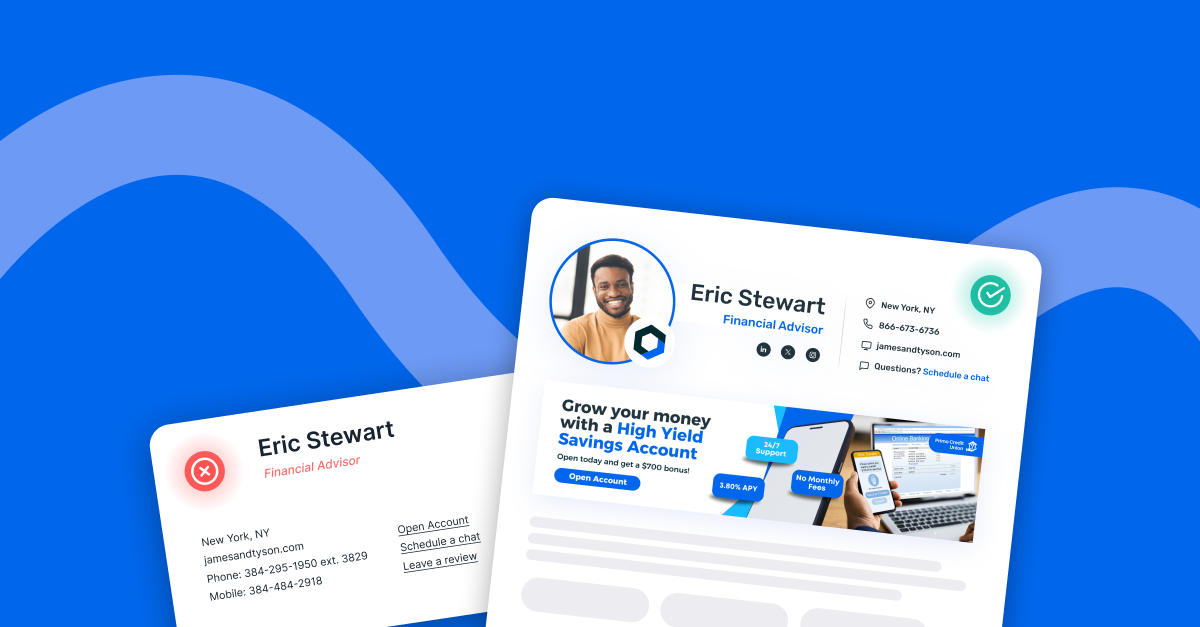
Two email signatures for a financial advisor — one ungoverned and flagged with an error icon showing inconsistent formatting and no branding, and one centralized and compliant through Opensense, showing a professional headshot, consistent contact details,
TABLE OF CONTENTS
Example H2

This is a div block with a Webflow interaction that will be triggered when the heading is in the view.

Example H3
Example H4
Example H5
Example H6
Key Takeaways
  • Most financial services firms govern their campaigns carefully and leave their highest-volume client touchpoint — employee email — completely uncontrolled.
  • When compliance and brand consistency break down at the signature level, there's no clean answer for regulators asking about CAN-SPAM or FINRA posture across employee-initiated communications.
  • The institutions getting ahead of this are treating employee email like every other governed channel: with infrastructure, standards, and a clear owner.
    • Your biggest compliance exposure isn't in the campaigns you review. It's in the millions of employee emails you don't.

      Why Employee Email Is Your Highest-Volume Ungoverned Channel

      Marketing and legal teams in financial services have invested heavily in governed channels — reviewed ads, approved campaign copy, documented disclosures. But there's a channel that operates at enormous volume, touches every client relationship, and sits almost entirely outside that governance model: everyday employee email.

      An advisor sends 30+ emails a day. A relationship manager follows up on every meeting. A wealth team responds to client inquiries in real time. Each of those interactions carries — or should carry — a standardized disclaimer, a compliant unsubscribe mechanism, and a consistent brand identity. Most don't.

      The problem isn't that institutions don't know this. It's that there's no system built to fix it.

      How Manual Signature Management Fails at Scale

      The traditional approach is manual: IT maintains signature templates, compliance reviews them periodically, employees update their own. The result is predictable. Signatures drift. Disclaimers get dropped. Opt-out links break. And when a regulator asks for documentation of your CAN-SPAM or FINRA compliance posture across employee-initiated communications, there's no clean answer.

      It rarely starts as a compliance initiative. It starts as a brand one. A marketing leader pulls up a handful of employee emails and realizes no two signatures look the same. Different headshots, different fonts, different phone numbers — some with disclaimers, some without. Some with an unsubscribe option. Most without.

      The IT team is managing it with a Word document template emailed to new hires. Or a script that half-applies a signature in Outlook. Neither is working.

      What started as "we need our emails to look consistent" becomes a reckoning: this channel operates at more volume than any campaign we run, and we have zero control over it.

      What Centralized Email Signature Governance Actually Looks Like

      What marketing actually needs from this channel

      Control over brand identity at the employee level — headshots, signatures, disclaimers — applied centrally, updated instantly, without an IT ticket every time someone gets promoted or changes their number.

      A defensible compliance posture: opt-out links that work, suppression workflows that run, disclaimers that can't be dropped by an employee who hits delete.

      And eventually — once the foundation is solid — the ability to activate the channel. Banners. Campaign rotations. Event promotion. Every employee email becomes a distribution surface, without adding send costs or rebuilding your tech stack.

      That's the sequence. Governance first, activation second. But you can't get to the second without the first.

      The institutions building this now aren't waiting for a compliance event to force the issue. They're treating employee email the way they treat every other governed channel: with standards, with infrastructure, and with a clear owner.

      SUMMARIZE WITH
      Does employee email fall under FINRA and CAN-SPAM compliance requirements?

      Yes. Employee-initiated emails — including advisor follow-ups, relationship manager outreach, and client correspondence — are subject to FINRA recordkeeping requirements and CAN-SPAM opt-out obligations. Centralized email signature management ensures disclaimers and unsubscribe mechanisms are applied consistently across every employee email, without relying on individuals to maintain them.

      Why does manual email signature management fail for financial services firms?

      Manual signature management — Word document templates, IT-managed scripts, employee self-service — breaks down at scale. Signatures drift between employees. Disclaimers get deleted. Opt-out links break. When a regulator asks for documentation of compliance posture across employee-initiated communications, there is no clean audit trail. Centralized management removes the human variable entirely.

      What is centralized email signature management?

      Opensense is a centralized email signature management platform that applies standardized signatures, disclaimers, and brand identity across every employee email from a single administrative control point. Updates — a new disclaimer, a changed phone number, a campaign banner — are pushed instantly across the organization without IT tickets or employee action.

      Can email signatures be used for marketing campaigns in financial services?

      Yes. Opensense establishes the compliance foundation first — consistent disclaimers, working opt-out links, enforced brand standards across every employee email. Once that infrastructure is live, the same channel can carry campaign banners, event promotion, and targeted messaging rotated by audience or deal stage. Governance comes first; activation follows.

      How does email signature management support a defensible compliance posture?

      Centralized email signature management enforces disclaimers centrally, so they cannot be dropped by an individual employee. Opt-out links and suppression workflows are built into every outgoing email automatically. Changes to required legal language are pushed across the organization immediately. The result is a documented, auditable compliance posture across every employee-initiated communication.

      Was this helpful? Share it!
      Opensense logo
      Jass Binning
      VP of Marketing at Opensense

      Jass Binning serves as the Director of Marketing at Opensense, where she oversees the strategic growth and brand positioning of the platform. Jass specializes in high-growth SaaS marketing, focusing on demand generation and brand consistency across complex digital landscapes. Her insights help marketers turn routine business processes into scalable revenue-generating opportunities.

      No items found.

      The Email Channel Your Marketing Team Doesn't Control — But Should

      May 7, 2026

      Your biggest compliance exposure isn't in the campaigns you review. It's in the millions of employee emails you don't.

      Why Employee Email Is Your Highest-Volume Ungoverned Channel

      Marketing and legal teams in financial services have invested heavily in governed channels — reviewed ads, approved campaign copy, documented disclosures. But there's a channel that operates at enormous volume, touches every client relationship, and sits almost entirely outside that governance model: everyday employee email.

      An advisor sends 30+ emails a day. A relationship manager follows up on every meeting. A wealth team responds to client inquiries in real time. Each of those interactions carries — or should carry — a standardized disclaimer, a compliant unsubscribe mechanism, and a consistent brand identity. Most don't.

      The problem isn't that institutions don't know this. It's that there's no system built to fix it.

      How Manual Signature Management Fails at Scale

      The traditional approach is manual: IT maintains signature templates, compliance reviews them periodically, employees update their own. The result is predictable. Signatures drift. Disclaimers get dropped. Opt-out links break. And when a regulator asks for documentation of your CAN-SPAM or FINRA compliance posture across employee-initiated communications, there's no clean answer.

      It rarely starts as a compliance initiative. It starts as a brand one. A marketing leader pulls up a handful of employee emails and realizes no two signatures look the same. Different headshots, different fonts, different phone numbers — some with disclaimers, some without. Some with an unsubscribe option. Most without.

      The IT team is managing it with a Word document template emailed to new hires. Or a script that half-applies a signature in Outlook. Neither is working.

      What started as "we need our emails to look consistent" becomes a reckoning: this channel operates at more volume than any campaign we run, and we have zero control over it.

      What Centralized Email Signature Governance Actually Looks Like

      What marketing actually needs from this channel

      Control over brand identity at the employee level — headshots, signatures, disclaimers — applied centrally, updated instantly, without an IT ticket every time someone gets promoted or changes their number.

      A defensible compliance posture: opt-out links that work, suppression workflows that run, disclaimers that can't be dropped by an employee who hits delete.

      And eventually — once the foundation is solid — the ability to activate the channel. Banners. Campaign rotations. Event promotion. Every employee email becomes a distribution surface, without adding send costs or rebuilding your tech stack.

      That's the sequence. Governance first, activation second. But you can't get to the second without the first.

      The institutions building this now aren't waiting for a compliance event to force the issue. They're treating employee email the way they treat every other governed channel: with standards, with infrastructure, and with a clear owner.

      LinkedIn iconX iconFacebook icon
      Was this helpful? Share the love.
      Opensense logo
      Jass Binning
      VP of Marketing at Opensense
      View all posts
      CONNECT WITH US
      LinkedIn iconX icon